Japanese Hand Tools Guide: Woodworking and Gardening Tools for Beginners
Jump to:
Japanese hand tools focus on precision, balance, and efficiency. Unlike many Western tools that rely on force, they emphasize control, allowing users to achieve accurate, clean cuts with less effort. In practice, this means smoother cuts, less material waste, and better-fitting joints, even for beginners.
Made from laminated high-carbon steel, these tools combine a hard cutting edge for sharpness with a softer backing for durability and shock absorption. This construction allows blades to stay sharp longer while reducing the risk of chipping under normal use.
In this guide, you’ll learn what makes Japanese hand tools unique, explore key woodworking and gardening tools, understand how to maintain them, and discover how to build a practical starter kit.
What are Japanese Hand Tools
Japanese tools are traditional hand tools designed for accuracy and control. A defining feature is the pull-stroke design, where tools like saws cut when pulled rather than pushed. This keeps the blade under tension, allowing it to be thinner, sharper, and more precise. As a result, users often find they can cut faster with less effort once they adjust to the technique.
Another key feature is laminated steel construction, where a hard cutting edge is bonded to a softer metal backing. This improves edge retention while maintaining strength and resistance to impact.
Compared to Western tools, which are typically designed for push-force cutting and heavier stock removal, Japanese tools prioritize finesse and surface quality. This makes them especially effective for fine woodworking and detailed joinery.
Key Japanese Hand Tools: Woodworking & Gardening Tools

Japanese hand tools are designed as a system, where each tool supports precise and controlled work.
- Saws (Nokogiri), such as Ryoba and Dozuki, produce narrow, clean cuts that improve joint fit and reduce material waste. For example, Dozuki saws have a reinforced spine, making them ideal for fine joinery like dovetails, while Ryoba saws handle both rip and crosscuts.
- Chisels (Nomi) are designed for carving, shaping, and joinery work, offering both strength and fine control. Their laminated construction allows them to hold a sharper edge longer than many standard chisels.
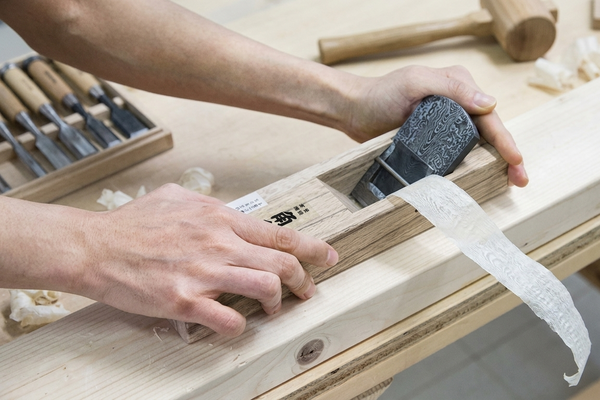
- Planes (Kanna) create extremely thin shavings, often leaving surfaces smooth enough to require little or no sanding. In skilled use, they can produce a polished finish directly from the blade.
- Axes and hatchets (Ono) are used for chopping and shaping wood, particularly in rough dimensioning or outdoor work.
- Marking tools like the Sumitsubo and Kiridashi knife enable precise layout and fine trimming, which is essential for accurate joinery.

For gardening, tools like the Hori-hori knife, Kama sickle, and pruning shears are commonly used for digging, cutting, and trimming. Their compact size and sharp blades make them especially effective in tight or detailed garden work.
Sharpening Tools and Whetstones

Sharpening is essential for maintaining Japanese tools. Because they use hard high-carbon steel, they can achieve extremely sharp edges, but they require regular maintenance to perform well.
Japanese whetstones are used to sharpen and refine blades. Typically, a 1000 grit stone is used for general sharpening, while higher grits (3000–6000) refine and polish the edge. Beginners often see immediate improvements in cutting performance after learning proper angle control. Regular sharpening not only improves performance but also extends the life of the tool by reducing excessive force during use.
If you want to learn sharpening, follow our step-by-step guide on How to Sharpen Knives with a Whetstone for precise, long-lasting edges, keep your tools in top condition with How to Sharpen a Japanese Sickle, and improve cutting performance with expert tips in How to Sharpen Saw Blades Like a Pro.
Choosing and Caring for Japanese Tools

Choosing the right tool depends on the task. For woodworking, consider the type of steel, handle comfort, and intended use. White steel (Shirogami) is easier to sharpen and ideal for beginners, while blue steel (Aogami) contains additional elements like chromium and tungsten, allowing it to hold an edge longer.
For gardening tools, look for forged blades, comfortable grips, and designs suited to specific tasks like digging, pruning, or clearing.
Tools should be cleaned and dried after use to prevent rust. Light oiling helps protect metal surfaces, while regular sharpening keeps edges effective. With proper care, these tools can last for many years.
Starter Kit: Essential Japanese Tools for Beginners

If you are starting, you only need a few essential tools.
For woodworking, a basic kit includes a Japanese multipurpose saw, a small chisel set, a hand plane, and a whetstone. This setup covers cutting, shaping, and finishing.
For gardening, a Hori-hori knife and pruning shears are sufficient for most common tasks.
This small set allows beginners to develop proper technique before expanding into more specialized tools.
Where to Buy Authentic Japanese Tools
When buying Japanese tools, look for forged construction, quality steel, and reputable makers or regions known for craftsmanship, such as Sanjo or Sakai. These factors are more important than brand alone.
Specialized retailers like Daitool provide a curated selection of Japanese hand tools, woodworking tools, and whetstones, making it easier to find tools suited to your needs and experience level.


0 comments