What is an Allen Wrench: Complete Guide to Types, Sizes, & Uses
Jump to:
The Allen wrench is one of those quietly essential tools that appear in a wide range of settings, from flat-pack furniture assembly and bicycle maintenance to industrial machinery, electronics, and precision engineering. Modest in form yet highly effective in function, it consists of a simple L-shaped shaft designed to tighten or loosen screws fitted with a hexagonal socket.
Despite its unassuming design, the Allen wrench has an important role in modern manufacturing and everyday DIY tasks due to its high torque transfer efficiency and reduced cam-out risk.
This guide covers what an Allen wrench is, how it works, its uses, types, sizes, and key considerations when using one.
What Is an Allen Wrench?

An Allen wrench, (also called a hex key) is a precision hand tool designed to drive fasteners with a hexagonal internal socket. It is widely used in mechanical assembly, furniture production, bicycle systems, and industrial equipment due to its compact form and high torque efficiency.
The tool is typically made from hardened steel or alloy steel to resist deformation under load. Its L-shaped design provides two functional leverage points:
-
Long arm: used for faster rotation and access in deeper or narrow spaces
-
Short arm: used for higher torque application when tightening or loosening resistant fasteners
Because the hex socket provides six contact surfaces, force is distributed across multiple contact faces. This reduces the likelihood of rounding compared to slotted or cross-head screws, especially under higher torque conditions.
Hex key fasteners are commonly specified in engineering applications where stability, flush installation, and resistance to cam-out is significantly higher than in slotted and Phillips (cross-head) drives
Allen Wrench Uses

Allen wrenches are standard tools in applications requiring compact, recessed fastening systems:
- Furniture assembly (flat-pack systems)
- Bicycle repair and drivetrain adjustment
- Appliance assembly and maintenance
- Industrial machinery assembly
- Electronics and mechanical prototypes
Their widespread use is driven by their ability to deliver controlled torque in confined spaces while maintaining fastener integrity.
Terminology (Allen Wrench vs Hex Key)
When it comes to the Allen vs Hex wrenchesn, the only difference is regional terminology, with the US favoring the term “Allen wrench” and the UK preferring the term “Allen key.” The hex key is a more generic term for tools used for nuts/bolts with a hexagonal socket and very often refers to Allen wrenches/keys.
The Origin Of The Allen Wrench
Between 1909 and 1910, William G. Allen was associated with the development and industrial adoption of hex socket set screws in the early 20th century, which contributed to the widespread use of internal hex fasteners in manufacturing. His company soon introduced the “Allen safety set screw,” designed to sit flush with machinery surfaces and help reduce workplace accidents.
At roughly the same time, other manufacturers, including Standard Pressed Steel (SPS), developed their own hex-socket fastener lines, most notably under the “Unbrako” brand, reflecting a wider industrial move toward internal-drive designs capable of handling higher torque with less wear.
These advances, combined with growing demand from rapidly industrializing sectors, established the hex key as an essential tool of the twentieth century. The Allen name became so closely associated with the design that it entered the lexicon as a generic term for the hex key.
How Does an Allen Wrench Work?

An Allen wrench operates by engaging a hexagonal recess in a fastener, creating full-surface contact between the tool and socket walls. This geometry enables efficient torque transfer with minimal slippage.
Because force is distributed across the six contact faces of the socket, stress concentration is reduced. This improves fastener integrity, particularly under high-torque or repetitive-use conditions.
The L-shaped design also changes mechanical advantage depending on orientation:
-
Longer lever = higher speed, lower torque control
-
Shorter lever = lower speed, higher torque output
This makes the tool adaptable for both precision and force-heavy applications.
Types of Allen Wrench
Several types of Allen wrenches have been designed to meet different applications and working environments.
Standard L-Shaped Allen Wrench

The most widely used format. Compact, inexpensive, and versatile. Suitable for general-purpose assembly and maintenance tasks.
T-Handle Allen Wrench

Designed for repetitive use and higher torque output. The handle improves grip stability and reduces hand fatigue, making it common in bicycle and workshop environments.
Ball-End Allen Wrench

Features a rounded tip that allows engagement at an angle (typically up to ~25°). Useful in restricted-access environments where direct alignment is not possible.
If you are looking for a set of ball-end wrenches, options include a KTC ball-end hex key set or an extra-long ball-end hex key set from Tone.
Ratcheting Allen Wrench

Incorporates a ratchet mechanism to allow continuous rotation without repositioning. Improves efficiency in high-volume fastening tasks.
Hex Key Sizes (Metric vs Imperial)

Metric and imperial hex key sizes are defined under different regional engineering standards, including ISO standards for metric systems and ANSI/ASME standards for imperial fasteners.
Metric (International standard in Japan and Europe)
- Typically range from 1.5 mm to 10 mm
- Common sizes include 2 mm, 2.5 mm, 3 mm, 4 mm, 5 mm, and 6 mm
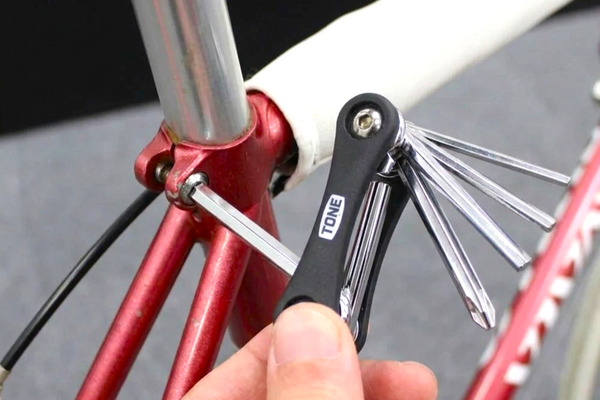
This Allen wrenches & screwdrivers multitool from Tone includes hex keys in the most common sizes from 2 mm up to 6 mm, as well as a slotted screwdriver.
Imperial (SAE, mainly used in the United States)
- Range from 1/16 inch to 3/8 inch
- Common sizes include 3/32", 1/8", 5/32", 3/16", and 1/4"
Although some metric and imperial sizes are very similar, for instance, 5 mm and 3/16 inch, they are not exactly the same. For that reason, it is important to select the precise size specified for the fastener.
Why Correct Sizing Matters
Using an Allen or hex key that is too large will typically not cause damage, as it will not enter the socket. The mismatch is immediately apparent: the tool will stop at the opening and fail to engage the fastener. In practice, this makes an oversized key a simple indication that a smaller size is required.
Using a key that is even slightly too small, however, can lead to fastener damage. An undersized tool may partially seat in the socket, giving the appearance of a correct fit. When torque is applied, the tool may slip within the recess instead of fully engaging the internal faces. This concentrates stress on the socket corners, increasing the risk of rounding or stripping the fastener, particularly under high load, excessive force, or pre-worn conditions.
For this reason, selecting the correct size is essential. A properly sized hex key should fully seat in the socket with a snug fit and minimal play. Hexagon socket key dimensions are standardized in ISO 2936. When correctly matched, the tool engages all internal faces of the socket, allowing torque to be transmitted efficiently and reducing localized stress on the fastener. This improves control during tightening and loosening and significantly reduces the risk of slippage or damage.
Final Thoughts on the Allen Wrench
The Allen wrench may look simple, but it is a highly efficient and reliable tool used across countless everyday and industrial tasks.
Its precise hexagonal fit, strong torque transfer, and compact L-shaped design make it both practical and versatile. From furniture assembly to machinery repair, it continues to be a standard tool in workshops and homes around the world.
Choosing the right type and size ensures safe use and helps prevent damage, making this small tool an essential part of any toolkit.


0 comments